Understanding how genetic diversity arises is central to evolutionary biology. For over a century, the dominant framework has emphasized random mutation as the primary source of variation, with natural selection acting as a filter that preserves advantageous changes. While this paradigm has been highly successful, increasing molecular evidence suggests that the processes generating variation within cells may be more structured and interconnected than traditionally assumed.
The DGbyRT hypothesis (Diversity Generation by Reverse Transcriptase) proposes that genetic variation may arise not only from random mutation, but also from structured interactions between key molecular processes within the cell. During gene expression, DNA is transcribed into RNA, and RNA molecules can, in certain contexts, be reverse-transcribed back into DNA. In parallel, homologous recombination enables the exchange of information between similar genetic sequences.
Rather than viewing these processes as separate and independent, DGbyRT considers the possibility that they may interact as a coordinated system of information flow. In this framework, genetic material is not only copied and altered, but also repeatedly compared, reused, and re-integrated into the genome.
This perspective suggests that part of genetic variation could originate from the internal dynamics of molecular information processing, where existing sequences contribute to the generation of new genomic configurations.
A central idea of this hypothesis is that the genome may contain not only active coding sequences, but also a broader repertoire of latent or historical information—fragments, repeats, and homologous regions that reflect past evolutionary solutions. Through RNA-mediated processes and sequence similarity, cells might access and recombine this information, generating variants that are influenced by existing biological context. This perspective does not replace random mutation or natural selection, but suggests that an additional layer of organization may exist in how variation is generated, with potential implications for evolutionary theory, genomics, and synthetic biology.
Current work focuses on developing both the theoretical and empirical foundations of the DGbyRT hypothesis. Theoretical efforts aim to formalize the interactions between RNA expression, reverse transcription, and homologous recombination into a coherent framework. In parallel, bioinformatics analyses are being developed to investigate whether signatures of homology-driven or RNA-mediated variation can be detected in genomic data. The goal is to identify measurable patterns that could support or challenge the hypothesis, and to guide future experimental validation in controlled systems.
Directed Evolution and the AutoDiMe Method
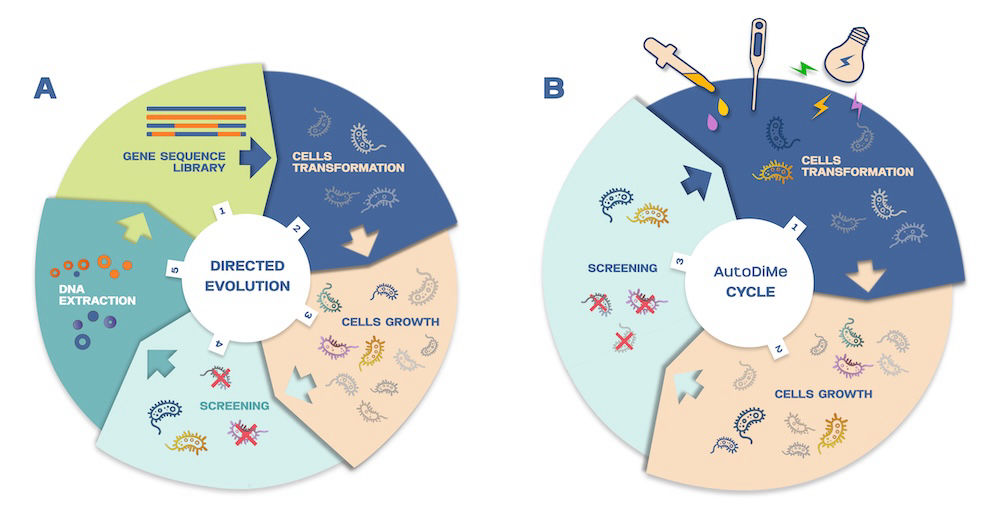
This figure compares classical directed evolution with the AutoDiMe method. In classical approaches, selected variants are isolated, and their DNA is extracted, recombined in vitro, and reintroduced into cells in iterative cycles. In contrast, AutoDiMe enables diversification directly in vivo through recombination of homologous, reverse-transcribed sequences. After initial setup, the process can proceed autonomously, allowing continuous generation and selection of variants within the cell population. External control (e.g., temperature shifts) can regulate or stop the process when desired outcomes are achieved.
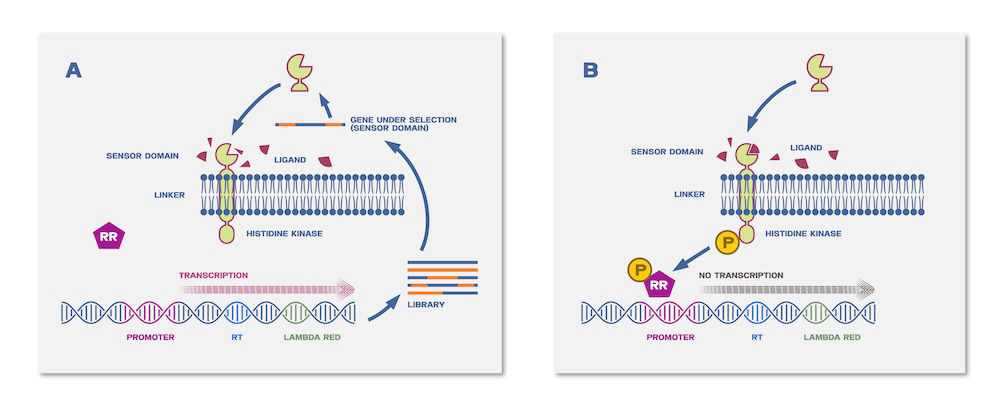
This schematic illustrates a synthetic system in which AutoDiMe (Autonomous Directed Mutagenesis) is coupled to a membrane receptor and signalling pathway. In the absence of ligand binding, AutoDiMe is activated, generating receptor variants through recombination of homologous domains. These variants are iteratively tested at the phenotypic level (ligand binding). When a functional receptor emerges, signalling is restored and AutoDiMe activity is reduced. This creates a feedback loop in which phenotypic performance influences the generation of genetic variation. The system models how functional outcomes can bias variation without implying directed mutation in natural systems.
Do you want to know more about my research?
You can download the links to my recent articles and preprints in the Downloads page.
Free AI Website Software